
CFB 26 Pipeline Map: Every Recruiting Region and the Schools That Own It
EA Sports doesn't give you an in-game visual map for recruiting pipelines. Instead, most players build their CFB 26 pipeline knowledge from disjointed Reddit threads, incomplete tables, and trial-and-error coach builds. This guide is the complete geographic breakdown to fix that.
Your pipeline choices set your program's floor and ceiling. Two things matter most: knowing which regions produce the highest volume of elite talent, and knowing what it costs in recruiting hours to visit those regions from your campus. Distance is not a flat rate in CFB 26, and picking the wrong pipeline burns hours you don't have.
This is a region-by-region reference: which schools own each pipeline and what it costs to recruit there. For the region-by-region ranking — which pipeline is best — see our best pipelines in CFB 26 guide.

How pipeline tiers work: the color code
Before looking at the map, understand the five-tier system. These tiers set your school's baseline recruiting pull in any given region.
The 5-tier color system

- Tier 1 (Bronze): weakest access. Minimal natural interest from recruits.
- Tier 2 (Silver): limited access. Hard to pull recruits against regional powers.
- Tier 3 (Gold): baseline regional footprint. Serviceable recruiting presence.
- Tier 4 (Blue): strong, high-volume pipeline. Natural contender for elite recruits.
- Tier 5 (Pink/Purple): elite pipeline. Maximum starting interest.
What do these tiers actually affect? According to extensive community testing by CollegeFootball.gg (run in CFB 25, but the conclusion is widely expected to carry over), pipeline tiers do not scale the weekly influence points from standard recruiting actions like Send the House (50 hours), DM (10 hours), Friends and Family (25 hours), or Social Media (5 hours). A Tier 5 pipeline and a Tier 1 pipeline return the same weekly influence increase from those actions.
Instead, pipeline tiers control two things: starting interest (where a recruit places your school on their initial list before you spend a single hour), and Hard Sell influence (the progress-bar jump when you run a Hard Sell — 40 hours; higher tier, bigger boost when your pitch aligns).
Your school's pipeline tiers are static throughout your dynasty run. They don't drift or change based on your on-field results. The only way to permanently upgrade a pipeline tier is by unlocking the Relationship Builder coaching skill (under the Program Builder archetype).
Why tier 4–5 is the critical threshold
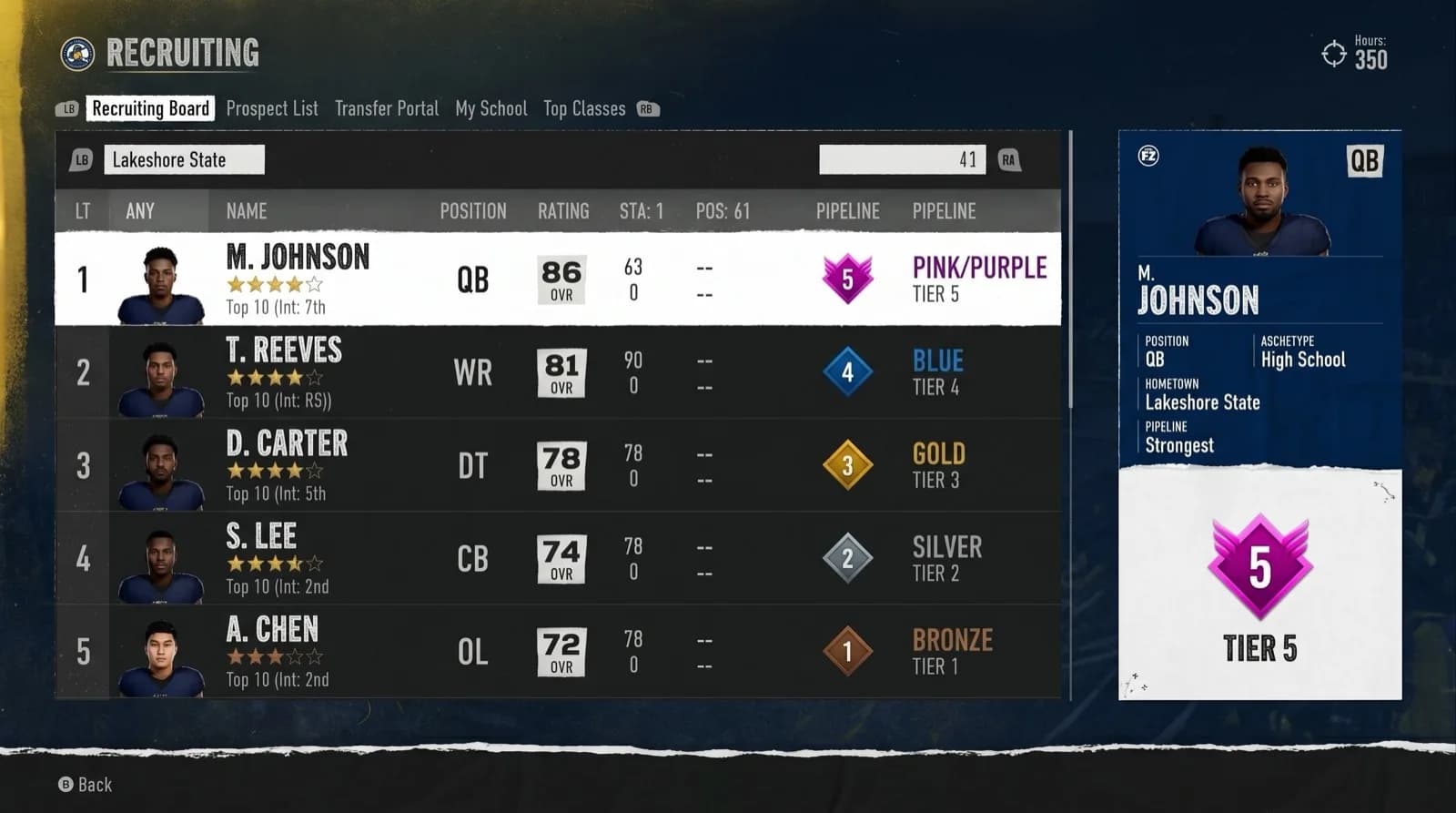
Programs with Tier 1 or Tier 2 access in a region compete at a structural disadvantage against any school holding Tier 4 or Tier 5. As community analyses on Operation Sports point out, a Tier 5 school holds its lead without burning massive hours, while a Tier 1 or Tier 2 school throws maximum weekly hours just to keep pace on the interest bar.
If you're chasing an elite recruit and a primary competitor holds Tier 5 while you're sitting at Tier 2, the pipeline math is stacked against you. Save your hours and find a winnable battle instead.
The Southeast: the elite talent zone
This is the highest-talent-density region in the game. If you want to build a national champion, you'll have to recruit here.
Metro Atlanta pipeline
The single most valuable pipeline in the game. Controlled tests by CollegeFootball.gg show that Metro Atlanta accounts for over 9% of all 5-star recruits across a 10-class aggregate period, roughly 2.9 five-stars per class on average. Georgia (Tier 5) and Clemson (Tier 5) hold top access here, with Auburn and Georgia Tech also holding strong footholds.
One trap worth flagging: don't pick Metro Atlanta as your coach pipeline if you're rebuilding a school in the Pacific Northwest or Mountain West. Proximity costs will offset your tier advantage and make those recruits highly inefficient to sign.
South Georgia pipeline
A top-10 pipeline for 5-star concentration. South Georgia is deep with physical defenders and skill-position talent. Georgia and Auburn hold Tier 5 access here, with Florida and Florida State also competing strongly. Combining a South Georgia or Metro Atlanta coach pipeline with an existing Southeast school footprint creates a powerful recruiting base.
Tidewater pipeline
This region covers the coastal Virginia and North Carolina corridor. It's a frequently searched pipeline because players want to know if it's worth dedicating resources here.
Alabama, Clemson, Maryland, North Carolina, and Penn State hold Tier 5 access in Tidewater, with Virginia Tech and Virginia also competing. It's a solid mid-to-high tier pipeline. If you're recruiting the Mid-Atlantic or Upper South, Tidewater is a reliable secondary talent source.
Position tendencies: real-world Tidewater is highly regarded for elite defensive backs and athletic skill players. Treat this as a community expectation until confirmed from recruit generation data.
The South: Texas and Louisiana corridors
Texas and Louisiana are the backbone of competitive roster construction, producing an elite balance of size and speed.
East Texas pipeline
A consensus top-5 pipeline across the community (Insider Gaming, Operation Sports). Baylor, TCU, Texas, and Texas A&M hold Tier 5 access here, with SMU and Houston also competing.
Position tendencies: community discussion links East Texas with big-bodied wide receivers and highly-rated offensive linemen. Treat this as a community report until confirmed from recruit generation data.
North Texas pipeline
North Texas and East Texas are distinct pipelines in CFB 26. North Texas covers the Dallas-Fort Worth metroplex and surrounding northern counties. Alabama, Oklahoma, Texas, and Texas A&M hold Tier 5 access, with TCU, SMU, and North Texas also competing. It's a contested region. If you play as SMU or TCU, stacking your coach pipeline here is critical to locking down your local backyard.
Southwest Texas pipeline
This pipeline covers the southern and western portions of the state, stretching toward Lubbock and El Paso. Generally lower 5-star density than East or North Texas — no team holds Tier 5 or Tier 4 here in the launch dataset. Texas Tech, UTSA, and Texas anchor control.
Louisiana pipeline
Highly regarded for powerful trench players on both sides alongside explosive skill players. LSU holds near-monopoly control with Tier 5 access. Tulane and Louisiana Tech have solid secondary positions.
If you're playing a non-LSU school in the South, look to get Tier 4 or Tier 5 access through coach upgrades to siphon off elite talent when LSU's board fills up.
Florida: the speed factory
Florida is the premier location for elite speed ratings at WR, RB, and DB. The Florida recruiting map splits into two distinct regions.
South Florida pipeline
A premium, high-density pipeline. Year-over-year community data shows South Florida is unmatched for pure athletic ratings. Alabama, Florida, Georgia, and Miami hold Tier 5 access, with Florida State and Texas A&M also competing.
If you're a national program looking to add elite speed, South Florida is a primary target. Expect heavy competition and high visit-hour requirements if you're based outside the Southeast.
Central Florida pipeline
Geographically separate from South Florida in the game, covering Orlando, Tampa, and the Space Coast. Alabama, Clemson, Florida, Florida State, Georgia, and Miami hold Tier 5 access, with USF also present. Central Florida has grown significantly in talent density. Stacking Central Florida with South Florida covers the full state's speed market.
Florida pipelines and visit cost
For an in-state program, having high tiers in both Florida pipelines is highly efficient. The proximity of central and south recruits keeps visit costs down to 10–15 hours per recruit.
The Mid-Atlantic and East Coast
Delaware pipeline
A well-searched pipeline as players try to figure out if the region is worth targeting. It covers Delaware, Maryland, and southern Pennsylvania. Maryland, Penn State, West Virginia, and Temple control it.
Delaware is not a national powerhouse. It has lower 5-star density than the deep South or Texas. For local Mid-Atlantic rebuilds like Temple, Maryland, or Rutgers, it's essential for securing your home footprint. Outside programs should expect a Tier 3–4 ceiling.
The Northeast: talent-sparse, niche use cases
The Northeast requires a specific strategy: recruit here for roster depth, not for elite blue-chip prospects.
Big Apple pipeline (New York/New Jersey)
A common search among players looking to rebuild regional programs. Rutgers and Syracuse hold the strongest presence. Expect solid offensive lineman and defensive back depth, but don't come here hunting for multiple 5-stars. It's one of the weaker pipelines for overall star-rating averages.
New England pipeline
Widely considered one of the weakest pipelines in the game. Boston College, UConn, and UMass anchor it. Don't select New England as your coach pipeline unless you're committing to a realistic regional challenge run. The talent pool is too sparse to work as a primary pipeline.
The West Coast: QB country
Southern California (SoCal) pipeline
Consistently a top-5 pipeline nationally. Known for elite quarterback prospects and high-tier skill-position talent. Arizona State, Oregon, UCLA, and USC hold Tier 5 access. For Midwestern or Southern programs, recruiting SoCal comes with a steep geographic travel cost.
Northern California (NorCal) pipeline
Covers the Bay Area through Sacramento. High concentration of 4-star and 5-star prospects. No team reaches Tier 5 here; California holds Tier 4. Stanford also competes.
Mountain West, Plains, and Midwest: rebuild central
These regions carry lower talent density but matter for specific rebuild paths.
Big Sky pipeline
Covers Montana, Idaho, Wyoming, and Nevada. This is a low-talent-density pipeline: 5-stars are rare, and the board will consist mostly of 2-star and 3-star prospects. It's the right pick for realistic rebuilds at programs like Boise State, Nevada, or Wyoming. National powerhouses shouldn't touch it.
Hawaii pipeline
Hawaii carries an isolation penalty: very low talent volume combined with high travel costs for almost every program in the country. Strictly for hardcore challenge runs or local Hawaii rebuilds.
Kansas pipeline
Low talent density. Anchored naturally by Kansas and Kansas State. If you're playing in this footprint, prioritizing the Relationship Builder archetype to upgrade pipeline tiers is worth doing early.
Wisconsin pipeline
Similar to Kansas, this is a regional anchor with a lower concentration of five-stars. It does reliably produce physical, run-blocking offensive linemen.
How your pipeline's location changes your visit costs
CFB 26 replaced the flat 40-hour visit cost from CFB 25 with a distance-based scale ranging from 10 to 40 hours per visit. The physical distance between your campus and the recruit's home city is the primary driver.
Proximity to Home drives the cost
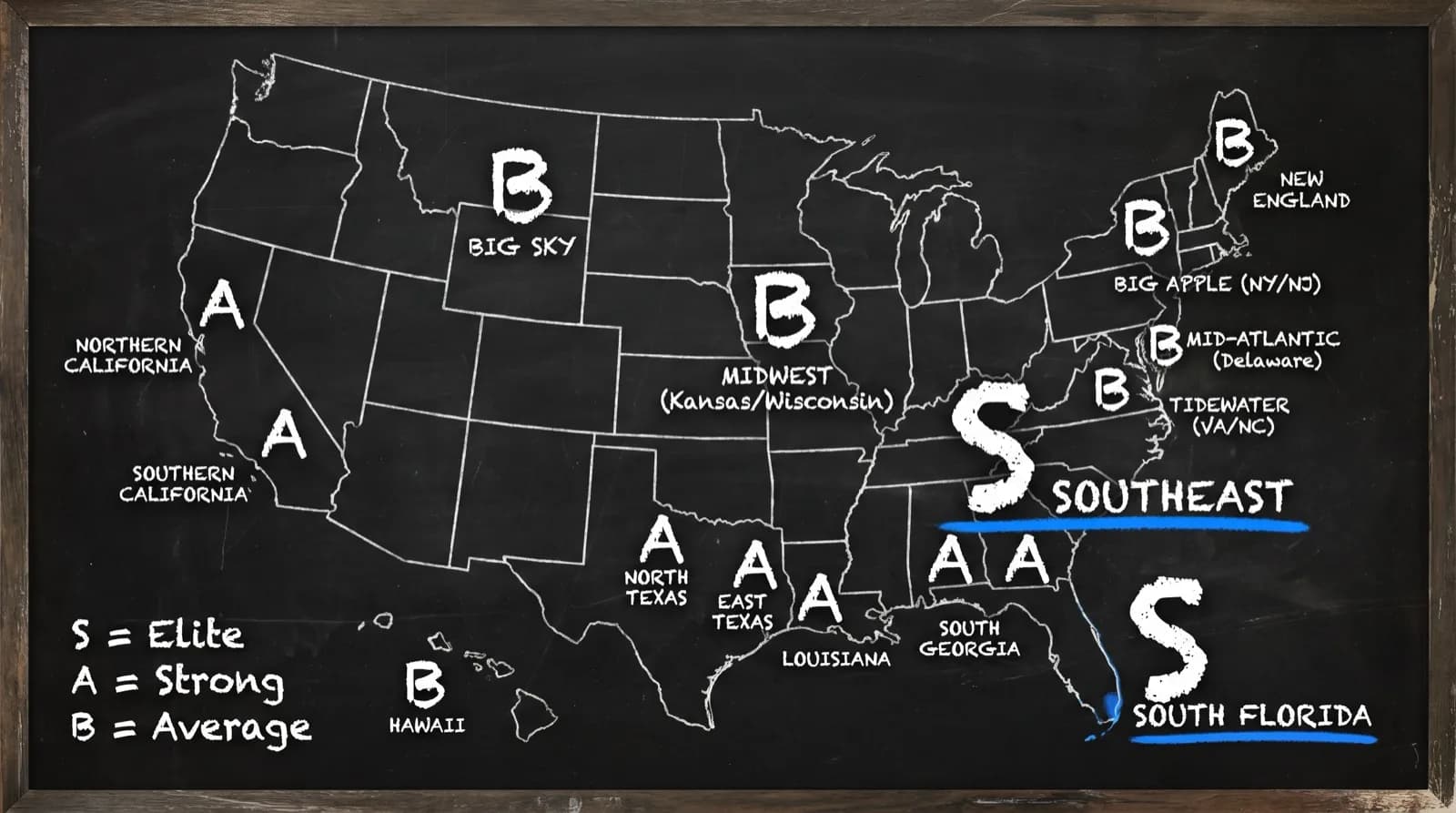
Your school's Proximity to Home grade ties directly to your campus's geographic relation to these pipelines. Recruiting inside your local pipelines earns a high Proximity to Home grade, which translates directly to lower visit costs.
A head-to-head worked example
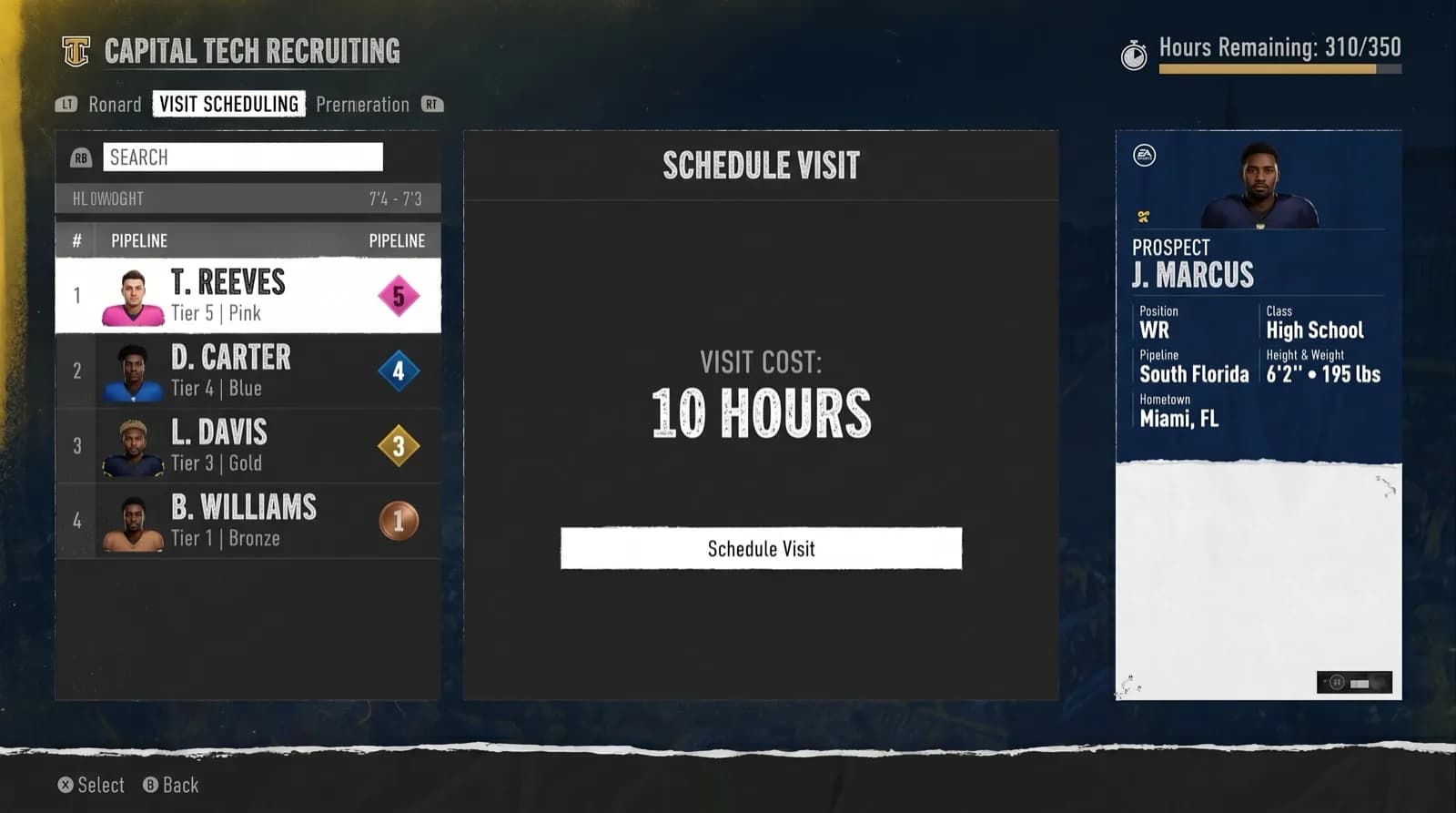
Consider Miami (FL) and Ohio State competing for a 5-star wide receiver out of Fort Lauderdale (South Florida pipeline):
- Miami (FL): local campus, South Florida Tier 5, Proximity to Home grade A+. Visit cost: 10 recruiting hours.
- Ohio State: out-of-region campus, South Florida Tier 2, Proximity to Home grade D−. Visit cost: 40 recruiting hours.
On visit week, Ohio State burns 40 hours just to get the recruit on campus. Miami does the same visit for 10 hours. That 30-hour gap is real. Miami takes that difference and immediately applies it to a completely separate target — Friends and Family (25 hours) plus Social Media (5 hours) on a different recruit, totaling exactly 30 hours spent. Ohio State can't do that; they're already tapped out.
Over a full recruiting cycle with a 25-man class, this efficiency gap is the difference between signing a top-5 class with 22 blue-chips or stalling at 15 prospects as your weekly hours run dry.
Recruiting on Reddit: finding community data
For players searching for "cfb 26 pipelines reddit," the main hub for empirical testing is r/NCAAFBseries.
What the community has verified
- The 5-star concentration test: CollegeFootball.gg's tracking of 5-star distributions (Metro Atlanta accounting for 9%+ of premium prospects across a 10-class aggregate) is the most reliable community dataset currently available.
- The hour boost test: community tests confirm that standard actions deliver flat values. No one has verified a hidden percentage boost to weekly basic influence based on pipeline tiers.
- No official figures: EA has not released the exact math behind pipeline tier boosts. Trust community tests and actual trial runs over speculation.
What changes in CFB 27 (July 9, 2026)
The biggest change for this map: Proximity to Home moves away from pipeline-based approximations. CFB 27 calculates real latitude/longitude coordinates between your campus and the recruit's home city. Pipeline tiers remain active but are now separate from the proximity calculation — you can be close to a recruit geographically and get the full Proximity to Home benefit even without a high pipeline tier there.
Pipelines still exist alongside pitching, scouting, My School grades, coach abilities, and NIL. The regional setups described in this guide are expected to carry over. For the full mechanic diff, see our CFB 27 pipeline changes guide.
Frequently Asked Questions
Where can I see all CFB 26 pipeline regions in one place?
There's no visual in-game map. The best free reference is CollegeFootball.gg's pipeline table, sortable by school and region. cfblabs.com has an interactive recruiting map, though parts of their data are locked behind a paywall. This guide is the most complete written reference for regional analysis.
What is the Tidewater pipeline in CFB 26?
Tidewater covers the coastal Virginia and North Carolina area. It's a solid mid-tier pipeline nationally, stronger than regions like New England but below premium talent zones like South Florida and Metro Atlanta. Alabama, Clemson, Maryland, North Carolina, and Penn State hold Tier 5 access here. It's a key pipeline for Virginia and North Carolina programs.
What is the Delaware pipeline in CFB 26?
The Delaware pipeline covers the Mid-Atlantic corridor: Delaware, Maryland, and southern Pennsylvania. Lower overall talent density than southern pipelines, but valuable for regional schools like Maryland to secure local depth. Maryland, Penn State, West Virginia, and Temple control it.
What is the Big Sky pipeline in CFB 26?
Big Sky covers the Mountain West region (Montana, Idaho, Wyoming, and Nevada). Low talent density; prospects here skew heavily toward 2-star and 3-star ratings. Rebuild programs like Boise State and Nevada are anchored here.
What is the Big Apple pipeline in CFB 26?
This pipeline covers New York and New Jersey. Useful for generating offensive linemen and defensive backs, but low 5-star density. Mainly used by regional schools like Rutgers as a home base.
Does recruiting from my pipeline region reduce my visit costs?
Yes. Your pipeline region ties to your geographic location. Recruits in nearby pipelines earn higher Proximity to Home ratings, reducing travel costs down to 10 hours compared to the 40-hour cost for distant schools.
Which pipeline has the most 5-star recruits in CFB 26?
Metro Atlanta. Community testing by CollegeFootball.gg confirms it accounts for over 9% of all 5-star prospects across a 10-class aggregate period. For the full region-by-region ranking, see our best pipelines in CFB 26 guide.
What are the worst pipelines to recruit from in CFB 26?
Big Sky, Hawaii, New England, Kansas, Wisconsin, and Big Apple. These regions have the lowest overall recruit density and star averages in the game. Stacking these on your board makes it hard to maintain a top-rated recruiting class.