
CFB 27 Pipeline Changes: What's Different and Why Proximity Just Split From Pipeline
CFB 27 is out, and the biggest recruiting question coming over from CFB 26 is simple: did pipelines change? The short answer is one confirmed change with real strategic weight, a stack of carry-overs and a few things the community wanted that EA did not announce before launch.
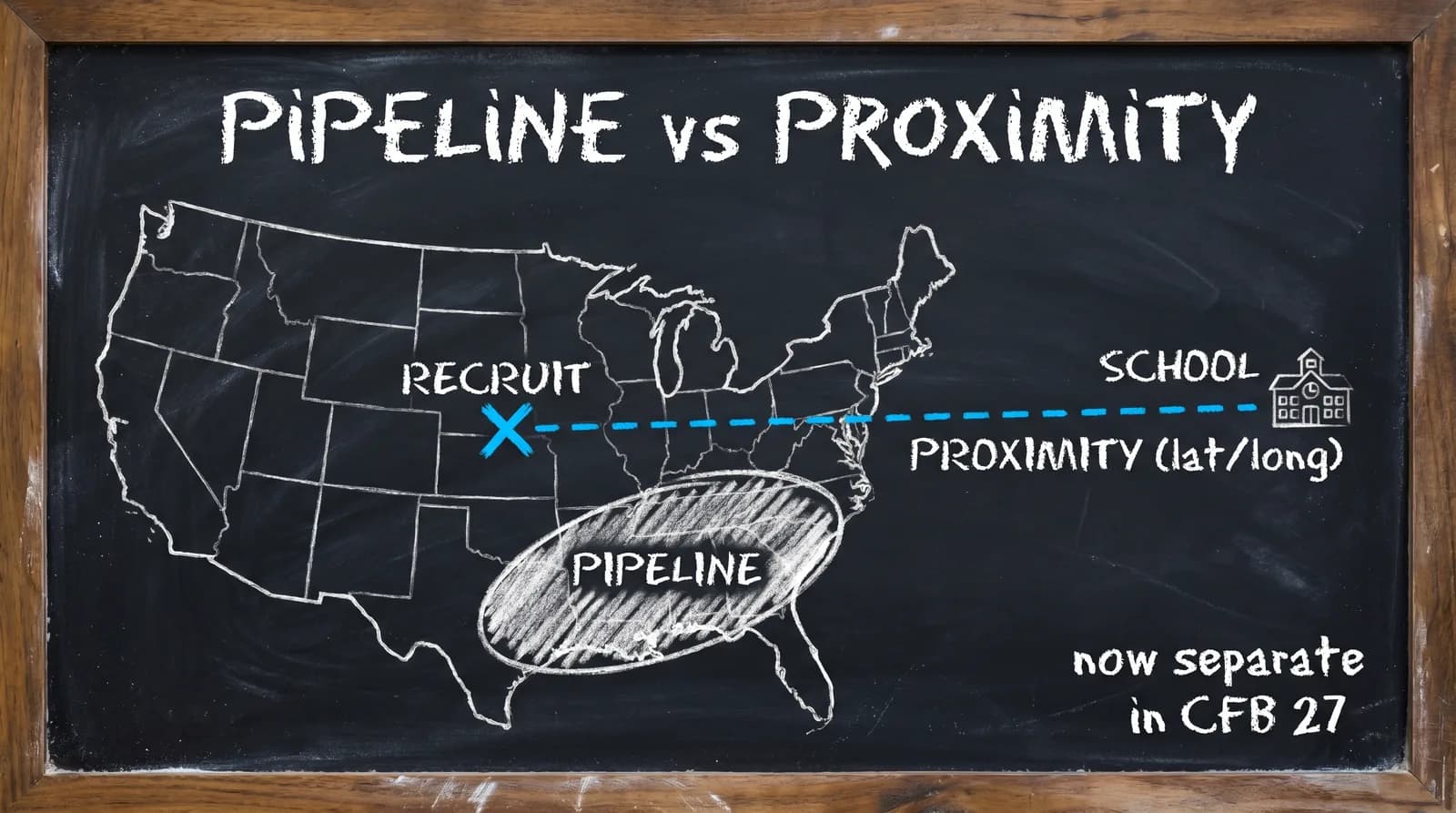
The one change that matters: proximity and pipeline are no longer the same signal. In CFB 26 your pipeline footprint stood in for how close a recruit lived. In CFB 27, Proximity to Home is its own grade, calculated from real latitude and longitude. This guide is the diff - what changed, what stayed and what EA left open. It rests on what EA announced before launch. We have not verified it in-game.
The Short Version
TL;DR
- Confirmed change: Proximity to Home now uses real lat/long distance, not a pipeline approximation. Proximity and pipeline are separate inputs for the first time.
- The verbal commit bonus is built from pipeline strength + Team Prestige + proximity - you earn partial credit for whichever you win (EA-confirmed).
- Scholarship offers are locked until Week 0 - the preseason is scouting only (EA-confirmed).
- Carried over: the pipeline tier system, and NIL stacks on top of pitches rather than replacing pipeline advantages.
- Not announced: dynamic pipelines. The community asked for them, but EA did not announce them before launch.
The One Confirmed Change That Matters: Proximity Now Uses Real Coordinates
In CFB 26, the Proximity to Home grade was tied to pipeline-based geographic approximations. In CFB 27, EA switched to actual latitude and longitude per city, so proximity and pipeline are two independent signals for the first time. A school physically close to a recruit earns a strong Proximity grade even with a low pipeline tier in that region.
Pipeline vs. Proximity, Side by Side
| Input | What It Is Now |
|---|---|
| Proximity to Home | Actual geographic distance from a recruit's hometown (lat/long). A close school scores well regardless of pipeline tier. |
| Pipelines | Regional recruiting infrastructure. A school can own a strong pipeline in a region without being close to every recruit in it. |
In CFB 26 these were blended into one signal. In CFB 27 they are explicit, separate inputs - so you no longer get implicit proximity credit just because you dominate a region's pipeline.
What This Means for Visit Costs
In CFB 26, visit costs ranged from roughly 10 to 40 recruiting hours by distance. With lat/long precision, those calculations should reflect true geographic distance more exactly. EA did not publish CFB 27 visit-cost values before launch, so treat the specific numbers as unconfirmed until you check them in your own save.
What This Means for Your School's Proximity Grade
The practical unlock: a mid-major near a talent-dense metro may now earn a stronger Proximity to Home grade than its pipeline tier ever suggested in CFB 26. If you are picking a rebuild, schools sitting close to top-recruit cities just got more interesting - their geographic advantage is now graded directly instead of being buried inside a pipeline approximation.
Why It Matters: The Verbal Commit Multiplier
The clearest mechanical consequence of the split shows up when a recruit verbally commits.
Three Factors, Partial Credit
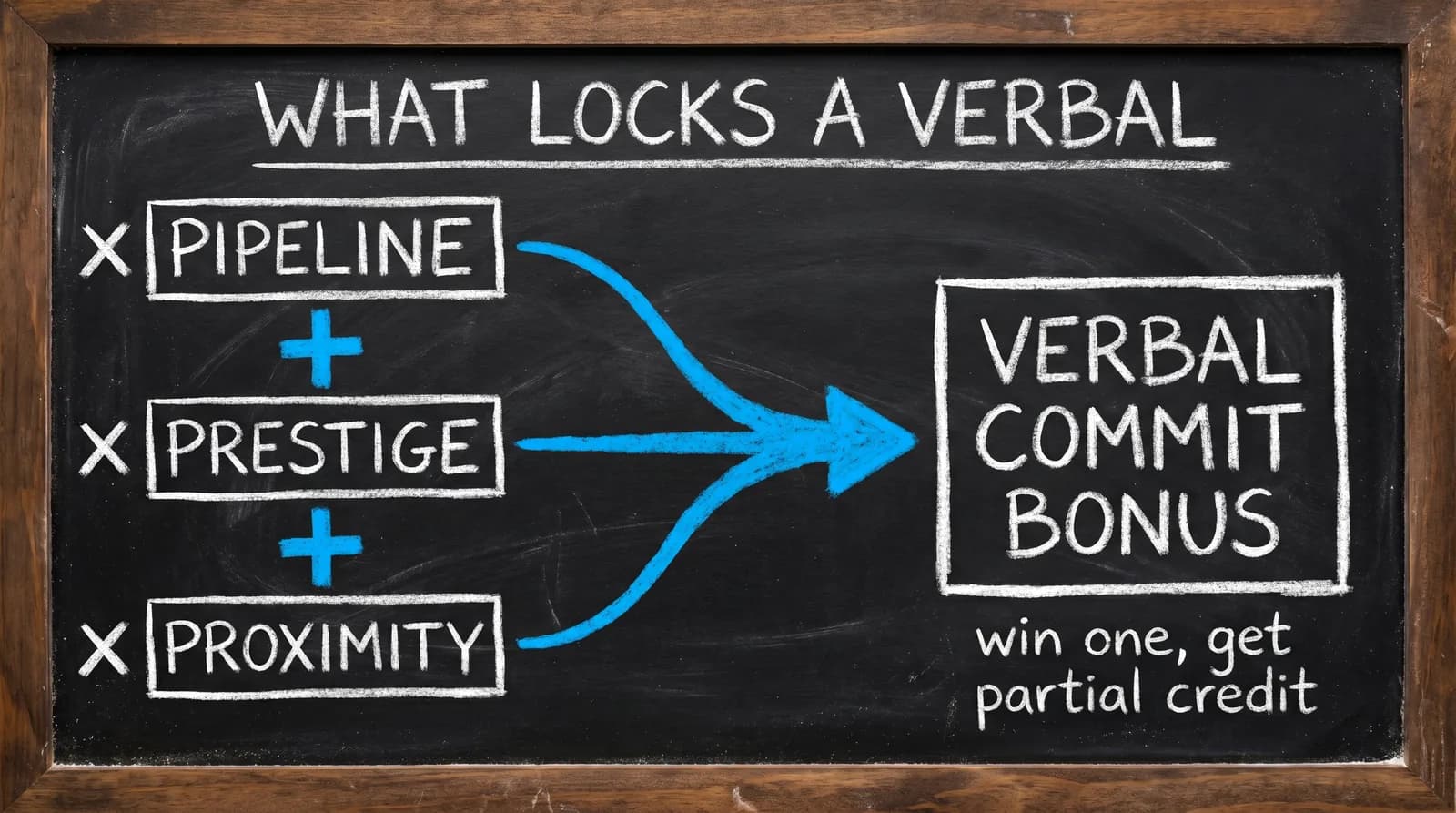
When a recruit verbally commits, the committed school gets a bonus influence multiplier on its recruiting actions, built from three factors: pipeline strength, Team Prestige, and Proximity to Home. Because proximity and pipeline are now discrete inputs, a school earns credit only for the factors it actually wins. A close school with weak regional pipelines gets proximity credit but no pipeline credit - and vice versa.
A verbal is not a Hard Commit. Top 3 schools can keep recruiting and flip the commitment before it locks. So a school that locked a verbal mostly on geographic closeness, but carries thin pipelines and middling prestige, is far more flippable than one that wins all three factors. The multiplier defending the commit is the product of all three, not proximity alone.
Another Change: No Offers in the Preseason
A smaller but important calendar change: scholarship offers are not available during the preseason in CFB 27. The preseason is dedicated to scouting, and formal offers do not open until Week 0 of the regular season. Pipeline relationships still exist before then - you just cannot convert them into offers early. Build your board during the preseason and pull the trigger once the season starts.
What Carried Over From CFB 26
Most of the pipeline system is intact. If you know CFB 26 recruiting, the foundation is familiar.
Still the Same
- The pipeline tier system carries over - tiers still represent your regional recruiting infrastructure alongside scouting, My School grades, pitches, and coach abilities.
- NIL stacks on top of pitches; it supplements your pipeline advantages rather than replacing them. A strong pipeline is still leverage that NIL alone cannot buy.
- Scholarship offers now carry an NIL component (a new recruiting mechanic, not a pipeline change).
- Coaching-carousel evaluations still factor pipelines when schools weigh candidates.
For how recruiting hours, pitches, dealbreakers, and the board all fit together, see the full CFB 27 recruiting guide linked below.
What the Community Wanted - But EA Did Not Announce
The most-requested pipeline feature is dynamic pipelines - tiers that grow or shrink based on your roster composition, coaching background, and recruiting success. EA did not announce this as a feature for CFB 27 before launch.
Based on everything EA disclosed before launch, assume pipeline tiers are static, fixed at dynasty creation unless you invest in the Program Builder ability path. Being honest about what is confirmed versus hoped-for is the whole point.
What to Lock In Before You Start a CFB 27 Dynasty
Four things worth deciding before you start a dynasty.
Before-You-Start Checklist
- Treat coach pipeline selection as permanent at dynasty creation - that is the CFB 26 rule, and we have not verified it in-game.
- Re-evaluate schools geographically close to talent-dense metros; the lat/long change may grade them stronger on Proximity than their pipeline tier implied.
- Treat school pipelines as static unless you plan to invest in the Program Builder path (carry-over - confirm in your save).
- Remember NIL hits your budget on day one; plan your scholarship spend before you start extending offers.
CFB 27 Pipeline Status: Confirmed vs. Not Verified
What EA confirmed, what should carry over and what we have not verified in-game.
Status at a Glance
| Mechanic | CFB 26 Behavior | CFB 27 Status |
|---|---|---|
| Pipeline tier system | Static tiers at start | System confirmed by EA; tier structure not verified in-game |
| Proximity to Home | Pipeline-based approximation | Confirmed change: real lat/long per city |
| Verbal commit bonus | Influence multiplier | Confirmed: pipeline + prestige + proximity, partial credit |
| Preseason offers | Available earlier | Confirmed change: locked until Week 0 (scouting only) |
| Visit cost range | 10-40 hours by distance | Carry-over expected - not verified in-game |
| Coach pipeline permanence | Locked at dynasty creation | Carry-over expected - not verified in-game |
| NIL in recruiting | Not in CFB 26 | New in CFB 27 - confirmed |
| Dynamic pipeline tiers | Not in CFB 26 | Not announced - community request only |
Track Your Recruiting Board With Dynasty Central
The pipeline-proximity split makes CFB 27 recruiting a more layered decision: which factors you win for each recruit, how that protects a verbal, and how it changes your NIL ask. Keeping that straight across a full board, and across seasons, is exactly the kind of tracking Dynasty Central handles.
Dynasty Central tracks your recruiting board, your pipelines, and your NIL commitments in one place so you can see where your real advantages are and spend accordingly. Start free and plan your CFB 27 recruiting before signing day.
Frequently Asked Questions
Did pipelines change between CFB 26 and CFB 27?
One confirmed change: Proximity to Home now uses real latitude and longitude per city rather than pipeline-based geographic approximations, decoupling proximity from pipeline tier for the first time. The pipeline tier system carries over, NIL is new but additive, and EA did not announce dynamic pipelines before launch.
How does the new lat/long Proximity to Home calculation change recruiting?
In CFB 26, proximity and pipeline were effectively linked. In CFB 27 they are independent. If your school is physically close to a recruit's home city, you earn a strong Proximity grade even if your pipeline tier in that region is low - so mid-majors near talent-dense metros can grade better than their tier suggests.
Do pipelines still matter in CFB 27 with NIL added?
Yes. EA lists pipelines as one of the core recruiting factors alongside scouting, My School grades, pitches, and coach abilities. NIL stacks on top of pitches - it does not replace the structural advantage of a strong pipeline.
What determines a verbal commit bonus in CFB 27?
The verbal commit influence multiplier is built from three factors: pipeline strength, Team Prestige, and Proximity to Home. Because they are now separate inputs, a school earns partial credit for whichever factors it wins - so a close school with weak pipelines is easier for Top 3 rivals to flip before Hard Commit.
Are pipelines dynamic in CFB 27?
Not confirmed. The community requested dynamic pipelines that grow or shrink with roster and recruiting success, but EA did not announce it for CFB 27 before launch. Assume tiers are static unless upgraded through the Program Builder path, and check your own save.
What should I know about pipelines before starting a CFB 27 dynasty?
Three things: treat your coach pipeline selection as permanent at dynasty creation, as it was in CFB 26; the lat/long proximity change means schools near talent-dense metros may grade stronger on Proximity than their tier implies; and NIL is a day-one budget factor in every scholarship offer, so plan before you extend.