
CFB 27 Top 10 teams, ranked for your dynasty
EA put out the official CFB 27 Top 10 by overall rating, and every site will rank them the same way: Oregon at the top, then down the list. That is the easy version, and it answers a question you are not really asking. You are not picking a team to admire. You are picking a team to run for the next ten seasons.
So we are going to read the same Top 10 a different way. An overall rating is a snapshot of the roster you inherit on day one. It says nothing about what your athletic director expects, how much room you have to climb, or how much of that talent walks out the door after year one. Those are the things that decide whether your dynasty is fun or a slow grind.
This guide publishes EA's official Top 10 overall, then re-sorts it by rebuild difficulty: the teams you maintain, the teams you build, and the ones we think are a regression trap, a high number about to lose the talent that earned it. That re-sort is our read, not EA's ranking. Use it to pick a dynasty that matches the climb you actually want, then plan it free in the Dynasty Blueprint planner.
EA's official CFB 27 Top 10 by overall rating
This is EA's official Top 10 overall for CFB 27. Read it once for the bragging rights, then read it again for the only thing that matters to a dynasty player: what kind of roster am I starting with, and how far is the ceiling above it.
The official Top 10 overall
| Rank | Team | Overall |
|---|---|---|
| 1 | Oregon | 91 |
| 2 | Ohio State | 90 |
| 3 | Indiana | 90 |
| 4 | Notre Dame | 89 |
| 5 | Texas | 89 |
| 6 | Miami | 88 |
| 7 | LSU | 88 |
| 8 | Ole Miss | 88 |
| 9 | Georgia | 87 |
| 10 | Oklahoma | 87 |
Two things from EA's reveal frame everything below. Oregon is the only 91 in the country, and EA has it sitting at the number 1 defense and the number 2 offense. Ohio State, one point back at 90, owns the number 1 offense. After those two, the list bunches up fast: four teams at 88, two at 87, and the gap from first to tenth is only four points of overall. On a national ranking that spread looks tight. As dynasty starting conditions, those four points hide completely different jobs.
The same Top 10, re-sorted by rebuild difficulty
Here is the reframe. We are not arguing with EA's overall ratings, those are the official numbers. We are sorting them by a different question: how hard is the dynasty, and what is the job in year one. This sort is our analysis and opinion, not an EA ranking. We see three buckets.
Maintenance: you inherit a finished roster and the expectations that come with it
Maintenance teams hand you a roster that is already at the top. The challenge is not climbing, it is not falling. The talent is here now, the athletic director already expects championships, and any season that is not a deep playoff run reads as a step back. This is the hardest difficulty for a different reason than a rebuild: there is no honeymoon.
- Oregon (91, number 1): the cleanest maintenance job in the game and, in our read, the highest expectation pressure. You inherit the only 91 overall, EA's number 1 defense and number 2 offense, and an athletic director who will treat a playoff miss as a failure. There is nothing to build. The whole dynasty is defending a peak while the roster ages and the recruiting bill comes due.
- Ohio State (90, number 1 offense): the other maintenance pick at the very top. You start with the best offense in the country and a program whose standard is national title or bust. EA used Ohio State as its example of an impatient athletic director, where even a strong season counts as a miss if you lose the rivalry game. Inheriting that roster means inheriting that ultimatum on day one.
- Georgia (87): the overall is two points lower, but the job is the same shape. The brand, the recruiting base, and the expectations all sit at the top of the sport. You are not rebuilding Georgia, you are protecting it, which is its own kind of pressure.
Build: a top-10 floor with real room to climb
Build teams are the sweet spot for most dynasty players. You start good enough to win now, with a clear gap between where you are and where the program could be. The athletic director expectations are demanding but not suffocating, and there is an actual climb to play out over multiple seasons. In our read, this is where the most replayable dynasties live.
- Oklahoma (87): a blue-blood brand sitting at the bottom of the Top 10 with the recruiting pull to push higher. You inherit a roster good enough to compete and a ceiling that is clearly above your starting overall. That is the textbook build, win now, recruit toward a title.
- Texas (89): higher floor than Oklahoma, same idea. Top-five overall, elite in-state recruiting, and the expectation that you turn a very good roster into a championship one. The talent base does a lot of the work, your job is to convert it.
- Notre Dame (89): a national brand and a top-five roster, with an independent path that changes how you schedule and climb. You start strong with a real ceiling above you, which is what puts it in the build bucket rather than maintenance.
- Ole Miss (88): the most interesting build on the board. A genuine top-10 roster at a program without blue-blood expectations baked in, which means the athletic director pressure should be lighter than the overall implies. Win-now talent, room to establish a program, less of a no-honeymoon trap. We think it is one of the better value picks in the Top 10.
The regression trap: a high number about to lose the talent that earned it
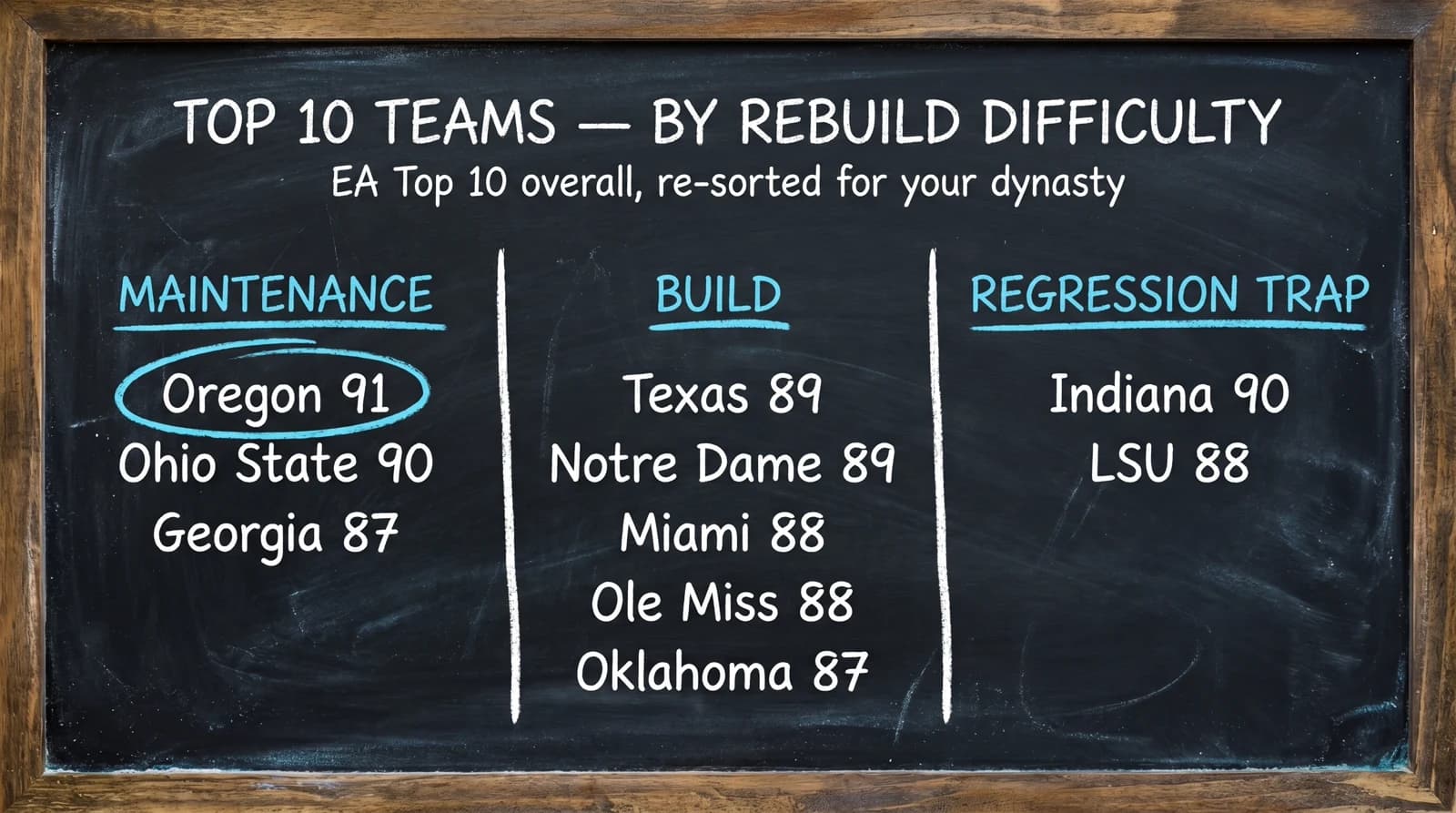
A regression trap is a team whose overall reflects last season's roster more than next season's. The number is real, but the players who earned it are leaving, and the dynasty you inherit is the cliff, not the peak. We think there is one obvious candidate in the Top 10, and the receipts are public.
Indiana (90, number 3 overall) is the one to read carefully. The jump is enormous: reporting on last year's game had Indiana at an 85 overall and ranked 18th, so this is a 90 and a number 3 that climbed from 85 and 18th in a single cycle. The roster that earned that climb is not the roster you inherit. Indiana lost the quarterback who won the Heisman, Fernando Mendoza, plus eight players to the NFL Draft. The case for Indiana is that it returns a loaded veteran defense and added quarterback Josh Hoover, so the floor is not the bottom. But starting your dynasty at a 90 that just shed its Heisman quarterback and eight draft picks is, in our opinion, the classic trap: a high number you have to defend with a roster that lost the reasons it got there.
Worth naming the other transition risk. LSU (88) is a strong roster, but a program in flux is a different dynasty than a stable one, and we would treat year one as a transition season rather than a finished article. Miami (88), on the other side, reads to us as the opposite of a trap: a top-10 roster with elite South Florida recruiting on its doorstep, one good cycle away from being a maintenance-tier program rather than a build. None of this is an EA judgment, it is how we would weigh the starting conditions.
How last year's list got rearranged (reported, for context)
The CFB 27 Top 10 is not a small shuffle from last year. To show why the regression-trap read matters, here is the year-over-year movement. These prior-year and preseason numbers are reported by their sources, not Dynasty Central ratings, and we cite them as contrast.
The big movers, attributed
- Indiana: reporting on the prior year's game had Indiana at 85 overall and 18th. EA's CFB 27 list has Indiana at 90 and number 3. That is the largest jump on the board, 85 to 90 and 18th to 3rd, and it is the engine of the regression-trap question.
- Alabama: reporting had Alabama at 89 and the number 1 overall last year. Alabama is not in EA's CFB 27 Top 10 at all. A blue blood falling out of the top 10 is the kind of swing that tells you how much a single offseason moved these rosters.
- Oregon: reporting had Oregon at 86 and number 9 last year. EA now has it at 91 and number 1, the only 91 in the game.
Real-world preseason ranks point the same direction without copying EA. Lindy's has Oregon number 1, Ohio State number 3, and Indiana number 5. Phil Steele has Indiana around number 5 to 6. So the human preseason consensus likes Indiana as a top-five-ish team, just not a number 3 roster, which is exactly the gap a dynasty player should feel when they boot up a 90 overall Indiana save. The talent is real. The 90 is the question.
Overall is not prestige, and prestige is what funds recruiting
One trap to avoid before you pick: do not read the overall rating as the program's standing. In CFB 27 they are different systems, and the one that drives your dynasty long term is prestige, not the day-one overall.
Why the prestige read matters more than the rating
EA's CFB 27 dynasty systems tie a program's resources to its prestige and brand, not to its current overall. Program standing sets the floor on your annual Dynasty Points budget, the pool you spend across coaching staff, facilities, and NIL. It also gates how many support staff slots you get, one per prestige level up to five. A higher-prestige program starts each season with a bigger budget and more levers to pull, before a single game is played.
That is why a 90 overall and a blue-blood 87 overall are not the same dynasty. A program with deep brand and a strong recruiting region carries that advantage every single year through the budget, while a roster that is rated high today but thin on prestige and brand has to spend more to hold the same ground. When you weigh a build pick like Oklahoma or Georgia, the brand is doing work the overall number does not show.
There is also a budget reason the regression trap stings. Two-sided NIL in CFB 27 means retention is a line item: every NIL offer you make, to recruits and to your own players, comes straight out of your Dynasty Points. A team that just lost its best players has to spend to reload and spend to keep what is left, all from one budget that does not roll over. Inheriting a 90 that needs a reload is more expensive than inheriting an 88 that is stable.
How to use this to pick your dynasty
Pick the job, not the number. The Top 10 has three different dynasties hiding in four points of overall. Match the one you start to the climb you actually want to play.
Match the team to the climb you want
- Want to defend a dynasty under pressure? Take a maintenance pick: Oregon, Ohio State, or Georgia. You inherit the talent and the expectation that you keep winning, with no rebuild runway. Hardest in a way that has nothing to do with roster holes.
- Want to win now with a real climb ahead? Take a build pick: Texas, Notre Dame, Oklahoma, or Ole Miss. Top-10 floor, a ceiling above you, and athletic director expectations that push without strangling. In our read, the most replayable dynasties.
- Thinking about Indiana at number 3? Go in with eyes open. You are picking a 90 that lost a Heisman quarterback and eight draft picks. If you want the challenge of defending a number you did not fully inherit, it is a great story. If you want a stable top-three roster, the number is selling you last season.
- Cross-check the road slate. A top-10 overall on a brutal road schedule plays harder than the rating implies. Pair this with our toughest places to play guide to see which of these teams have to go win in November.
- Then plan it before you start. Drop your pick into the free Dynasty Blueprint planner and it turns the starting conditions, the budget, and the expectations into a posture for the season instead of a guess.
Plan your Top 10 dynasty in Dynasty Central
The pick is the first decision. The next ten seasons are the dynasty. Dynasty Central is built for the part the ranking lists skip: running the program after you choose it.
From a pick to a tracked dynasty
Start with the free Dynasty Blueprint planner. Feed it your team and it reads the starting conditions this guide describes, the inherited roster, the prestige and brand, the athletic director expectations, and turns them into a plan for the season ahead. It is built for exactly the maintenance-versus-build decision the Top 10 forces.
Once your save starts, you do not just pick, you track. Create a free Dynasty Central account, screenshot-import your roster and recruiting board, and keep your roster, recruiting targets, Dynasty Points allocation, schedule, and season results in one place across multiple seasons. With two-sided NIL and a budget that does not roll over, that season-over-season tracking is the difference between running a program and playing spreadsheet. The free tier includes one dynasty, which is all you need to commit to a single Top 10 save and see the climb through.
Frequently Asked Questions
What are the Top 10 teams in CFB 27?
EA's official CFB 27 Top 10 by overall rating is: 1 Oregon (91), 2 Ohio State (90), 3 Indiana (90), 4 Notre Dame (89), 5 Texas (89), 6 Miami (88), 7 LSU (88), 8 Ole Miss (88), 9 Georgia (87), and 10 Oklahoma (87). Oregon is the only 91 in the game, with EA's number 1 defense and number 2 offense, while Ohio State has the number 1 offense.
What is the best Top 10 team to start a dynasty with in CFB 27?
It depends on the climb you want, not on the overall. In our read, the most replayable dynasties are the build teams: Texas, Notre Dame, Oklahoma, and Ole Miss, which give you a top-10 floor with real room to climb. If you want maximum pressure with no rebuild runway, the maintenance picks are Oregon, Ohio State, and Georgia. This sort is our analysis, not an EA ranking.
Why is Indiana ranked number 3 in CFB 27?
EA gave Indiana a 90 overall and the number 3 spot in CFB 27. Reporting on last year's game had Indiana at 85 overall and 18th, so this is a large single-cycle jump. Our opinion is that it is a regression trap for dynasty players: Indiana lost the Heisman-winning quarterback Fernando Mendoza and eight players to the NFL Draft, so the roster you inherit is not the one that earned the 90. It does return a veteran defense and added quarterback Josh Hoover, so the floor is not the bottom, but you are defending a high number with a thinner roster.
Is Alabama in the CFB 27 Top 10?
No. Reporting had Alabama at 89 overall and number 1 in last year's game, but Alabama is not in EA's official CFB 27 Top 10. A blue blood falling out of the top 10 in one offseason is one of the bigger swings on this year's list, and it is part of why we treat single-cycle ratings jumps with caution.
Does a higher overall mean an easier dynasty in CFB 27?
Not necessarily. A high overall can mean a maintenance dynasty with championship-or-bust expectations and no rebuild runway, which plays harder than a lower-rated build team with room to climb. Overall is also not the same as prestige: in CFB 27, a program's prestige and brand set its Dynasty Points budget and support staff slots, so a blue blood rated 87 can be better resourced year over year than a 90 with thinner brand.
How do I plan a CFB 27 Top 10 dynasty?
Use the free Dynasty Blueprint planner. It reads your team's starting conditions, the inherited roster, prestige, and athletic director expectations, and turns them into a posture for the season instead of a guess. Then create a free Dynasty Central account, screenshot-import your roster, and track your Dynasty Points allocation, recruiting board, schedule, and results across multiple seasons.