
CFB 27 AD Expectations and Job Security
In CFB 27 you do not just build a roster - you answer to an Athletic Director. Every season your AD sets three concrete goals, and how you perform against them drives your job security. Miss too much at an impatient school and you are fired; deliver at a patient one and you get years to build.
But AD Expectations are more than a job-security meter. Completed goals pay bonus Dynasty Points, which means hitting your targets directly funds next year's roster. Understanding how goals and School Demeanor work is the difference between a rebuild that survives long enough to win and one that gets you run out of town in Year 2.

The Short Version
TL;DR
- Your AD sets three goals every season, and you see all three before the season starts.
- School Demeanor (Patient, Balanced, or Impatient) sets how much patience you get.
- Some goals are firm - missing them can get you fired. Others are stretch goals with less downside.
- Completed goals pay bonus Dynasty Points at the End of Season Recap, so goals are also income.
- Standards escalate: what satisfies your AD in Year 1 will not satisfy them in Year 5.
- On the coaching carousel you can scout a job's demeanor, budget, and expectations before you accept.
The Three Goals
Your AD sets three active expectations per season. They vary by school and difficulty, but they always fall into a defined set of categories - and you can see all three before you ever kick off.
Goal Categories
- Winning national or conference championships
- Beating specific rival schools
- Hitting statistical benchmarks (a ranked defense, a top-10 scoring offense, and the like)
- Signing recruits of a certain star rating, position, or region
- Controlling recruiting territory
- Improving or maintaining facilities
- Finishing in the Top 25 or higher
- Reaching a required win total
Most goals are single-season targets, but some span multiple years. Because you see all three before the season starts, you can plan your recruiting, scheduling, and Dynasty Points spending around the goals you actually intend to complete.
Not All Goals Carry Equal Weight
Some goals are firm expectations where falling short creates real job-security downside. Others are stretch objectives where missing may not cost you the job. The game shows you the distinction, so the strategic move is obvious: protect the firm goals first, and treat stretch goals as upside rather than obligations. A rebuild that quietly nails its firm goals every year buys the time it needs, even while losing the splashy ones.
School Demeanor: Your Leash
Each program has a Demeanor that determines how much patience the AD extends. It is the single biggest factor in how survivable a job is.
The Three Demeanor Types
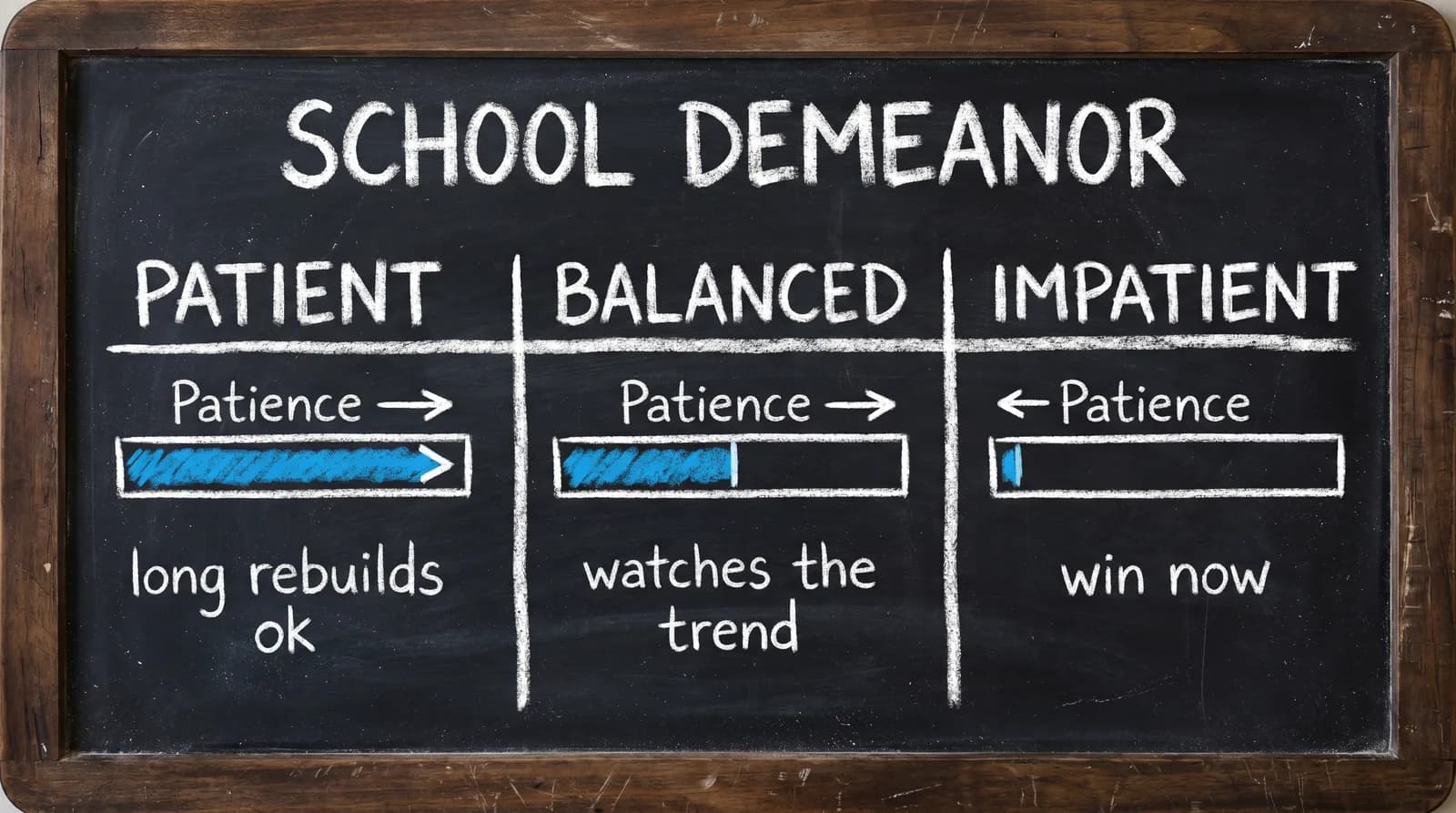
| Demeanor | Behavior |
|---|---|
| Patient | Allows long-term development; will not overreact to a single missed goal. A real rebuild gets multiple seasons. |
| Balanced | Evaluates the trend across multiple seasons. Year 1 is a wash; Year 2 needs visible improvement. |
| Impatient | Demands results now, with little margin for error. Miss a goal early and the pressure is immediate. |
Here is the key insight: a 9-win season means completely different things at different schools. At an impatient blue blood, 9 wins can be a failure. At a patient program two years into a rebuild, the same record is clear progress. Read the demeanor before you take the job, not after.
Demeanor Also Shapes Your Budget
Demeanor does not just set your patience - it nudges your Dynasty Points budget. Patient schools tend to start slightly lean, because the AD is comfortable waiting for results. Impatient schools tend to inflate the budget to give you a fighting chance at the aggressive goals they demand. That trade matters when you compare jobs: a patient job with a smaller budget is a marathon, while an impatient job with a bigger budget is a sprint with a short fuse.
Goals Are Income, Not Just Pressure
It is easy to read AD Expectations as pure job-security stress, but they are also one of your four Dynasty Points income sources. Each completed goal pays a bonus at the End of Season Recap, on top of your base budget, postseason bonuses, and fundraising.
That reframes how you plan a season. Deliberately structuring your early years around goals you can realistically complete is not just career protection - it is a budgeting move. Hitting two or three completable goals a year compounds: the bonus points fund better recruiting and facilities, which make next year's goals easier to hit, which pays out again. For a rebuild operating on a tiny budget, those goal bonuses can be a meaningful slice of the entire pool.
The flip side is a trap worth naming: chasing a flashy stretch goal you are unlikely to complete can cost you the steady income from the firm goals you sacrificed to chase it. Bank the reliable bonuses first.
Standards Escalate Over Time
AD Expectations are not static. As your program grows, the standard grows with it. Sustained success raises the baseline for future seasons, so what satisfies a patient AD in Year 1 will not satisfy that same AD in Year 5 of a strong run.
This is the hidden tax on winning. Take a program from the bottom to a conference title and your reward is a tougher goal sheet next season - the AD now expects you to stay there. Plan for it: the budget and roster you build during the patient early years need to be strong enough to clear the higher bar that success itself creates. A dynasty does not get easier as it gets better; the goalposts move.
Scout the Job Before You Take It
The overhauled coaching carousel turns job selection into a scouting exercise. You no longer accept a job blind.
What You See Before Accepting
When you enter the job market, you can express interest in multiple openings and see the full picture before committing: the Dynasty Points budget, the facility tier, the AD's expectations, the School Demeanor, and your projected payout. You are effectively reading a contract.
That lets you compare jobs that look similar on the surface but play very differently. A patient school with a modest budget and low prestige is a different job than an impatient school with a big budget and brutal goals. One is a slow build with a long leash; the other is win-now with no rope. If you are new to the Blueprint, take the patient job - the budget and patience together decide how hard the dynasty actually is, and a forgiving demeanor covers a lot of early mistakes.
One more note on the carousel: Coach Prestige, not Coach Level, is now the primary factor schools evaluate you on. You are judged on recent accomplishments, so a strong few seasons at a smaller program is the fastest route to a better job.
Track Your AD Goals With Dynasty Central
AD Expectations connect everything: they gate your job, they pay your budget, and they escalate as you win. Tracking three goals a year, their firm-versus-stretch weight, and the bonus points each one pays - across multiple seasons - is exactly the kind of bookkeeping Dynasty Central handles for you.
Dynasty Central tracks your AD goal progress through the season, flags which goals are firm, and ties their payouts into your Dynasty Points budget so you can see how job security and spending power move together. Start free and never get blindsided by a missed goal again.
Frequently Asked Questions
What are AD Expectations in CFB 27?
AD Expectations are the three goals your Athletic Director sets each season in CFB 27 dynasty mode. Your performance against them drives your job security, and each completed goal also pays bonus Dynasty Points at the End of Season Recap. You can see all three goals before the season begins.
What is School Demeanor in CFB 27?
School Demeanor is a program's personality, and it sets how patient the AD is. Patient schools tolerate long rebuilds, Balanced schools judge your multi-season trend, and Impatient schools demand immediate results with little margin for error. Demeanor also nudges your Dynasty Points budget.
How do you get fired in CFB 27 dynasty?
By consistently missing your AD's firm goals, especially at an impatient school. Some goals are firm expectations where falling short creates real job-security downside, while others are stretch goals with less consequence. Patient schools give you multiple seasons; impatient schools can move on quickly.
Do AD goals give you Dynasty Points in CFB 27?
Yes. Completing an AD Expectation goal pays a bonus of Dynasty Points at the End of Season Recap. AD goals are one of the four Dynasty Points income sources, alongside your base school grades, postseason bonuses, and annual fundraising.
Do AD Expectations get harder over time in CFB 27?
Yes. Expectations escalate as your program grows. Sustained success raises the baseline, so what satisfies your AD in Year 1 will not satisfy them in Year 5 of a strong run. Winning effectively raises the bar you have to clear next season.
Can you see a job's expectations before taking it in CFB 27?
Yes. On the coaching carousel you can see a job's Dynasty Points budget, facility tier, AD expectations, School Demeanor, and projected payout before you accept. Coach Prestige, based on recent accomplishments, is now the primary factor schools use to evaluate you.