
How Pipelines Work in CFB 26: Tiers, Colors, and What They Actually Do
Pipelines simulate a program's geographic pull. Every school has a historical recruiting footprint, and every recruit spawns inside a specific territory.
The in-game interface does a poor job of explaining what different tier levels mean, how they stack, or where CFB 26 pipelines actually touch your strategy. It also does not tell you where they do absolutely nothing.
If you are trying to figure out which recruiting battles are worth your limited hours, use this as the mechanics explainer — then jump to the full CFB 26 pipeline ranking when you need the region-by-region list.
What is a pipeline in CFB 26?
A pipeline is a school's geographic recruiting reach. The game assigns each school a preset strength level across different geographic regions rather than treating every location the same.
Your geographic recruiting pull

Think of a pipeline as a permanent geographic advantage. A high-tier pipeline in South Florida or East Texas means your staff has established local connections, high school relationships, and built-in brand awareness in that area.
That geographic gravity is the starting point for your recruiting board. Knowing which regions you can actually win, and which ones just bleed hours, is the difference between building a legitimate class and spinning your wheels on unwinnable battles.
The 5-tier system: what the colors actually mean
The game assigns pipeline strength using five tiers, but the UI shows only unlabeled colored icons. Use this table to decode your board.
Pipeline color tiers
| Tier | Color icon | Strength |
|---|---|---|
| Tier 5 | Pink / Purple | Strongest |
| Tier 4 | Blue | Strong |
| Tier 3 | Gold | Average |
| Tier 2 | Silver | Below average |
| Tier 1 | Bronze | Weakest |
The community frequently swaps "pink" and "purple" when describing the Tier 5 icon. Both refer to the same top-tier in-game asset.
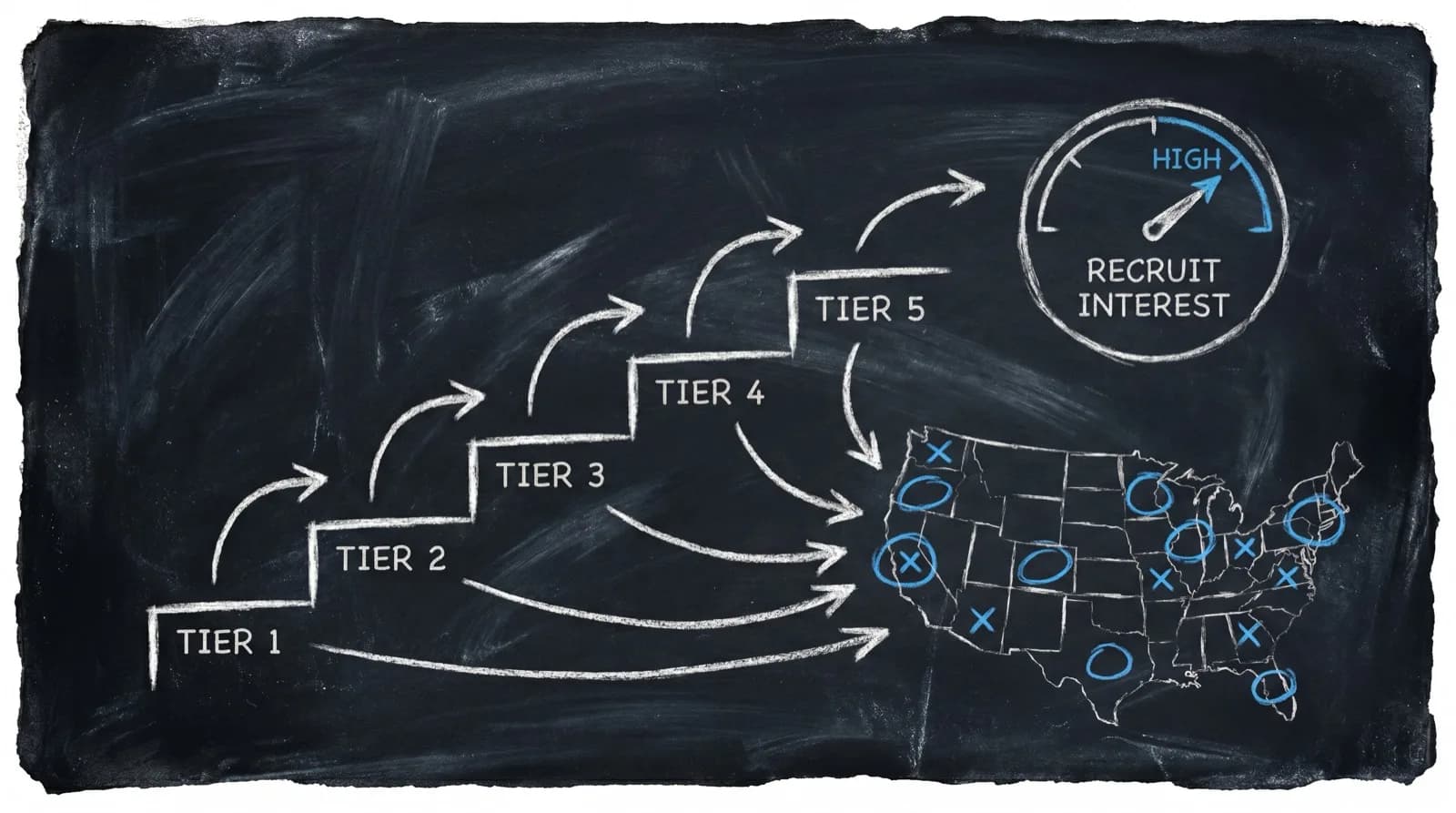
The gap between tiers is not cosmetic
The gap between a Tier 1 pipeline and a Tier 5 is large enough to decide battles before you run a single recruiting action.
Take a real example: you are rebuilding a Sun Belt program like App State with a Tier 2 pipeline in North Carolina. UNC or Georgia goes after the same local recruit with their Tier 5 pipeline. Even maxing your weekly hours, the starting interest gap is practically impossible to close through standard recruiting actions.
EA has not published exact percentages, and the community has not fully reverse-engineered them either, but the direction is clear: fighting a Tier 5 school with a Tier 1 or Tier 2 pipeline is a battle you lose 9 times out of 10.
The three-layer pipeline system
Standard recruiting guides treat pipelines as a flat, single value. In reality, they operate as three distinct, independent, and stackable layers.
All three layers stack
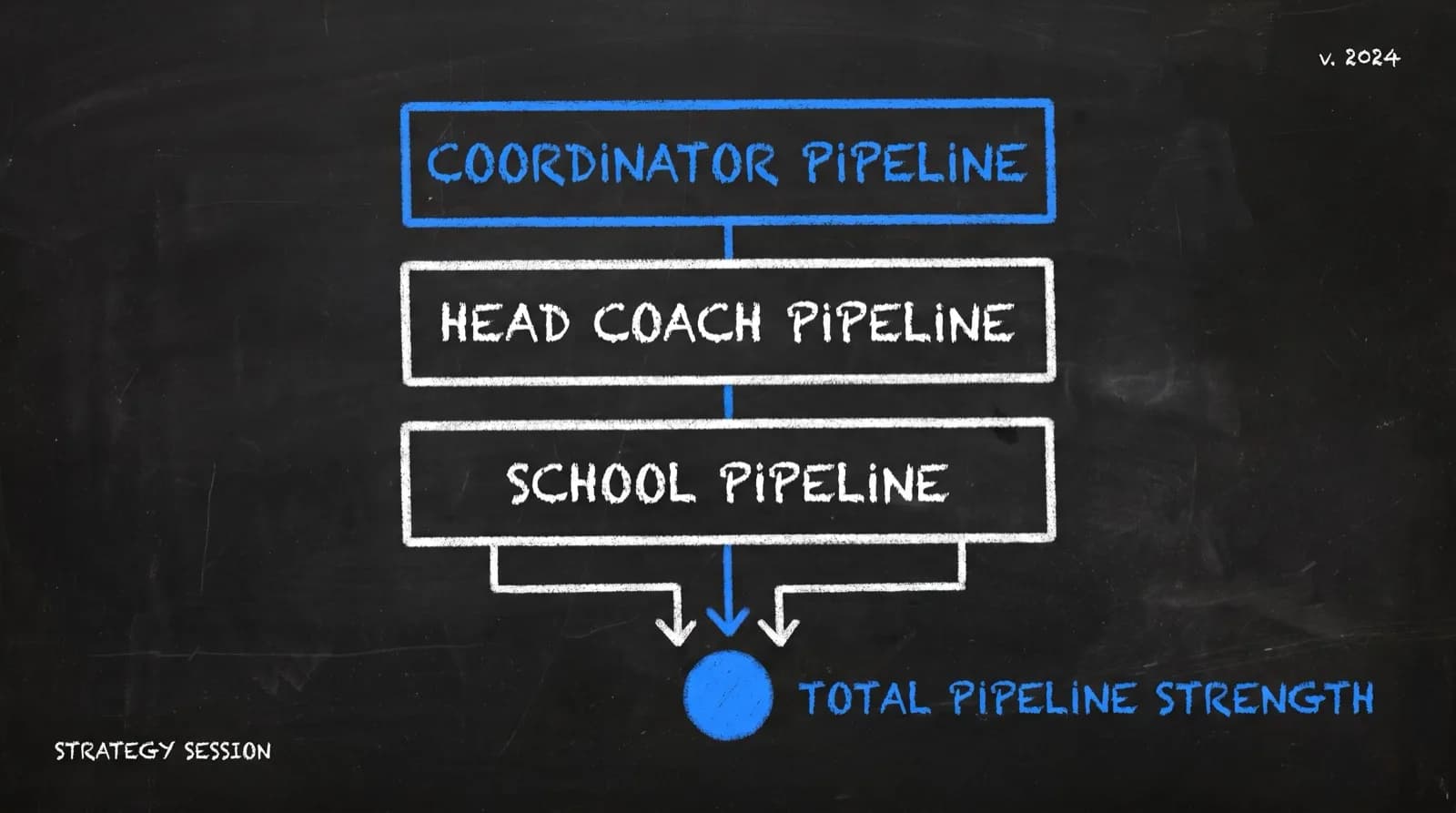
Layer 1: school pipeline
The default pipeline map hardcoded to your program. It is based on real-world geography and branding. These tiers are static by default and will not grow on their own across seasons, no matter how many games you win.
Layer 2: head coach pipeline
The single region you pick during coach creation. It adds a separate, stackable weekly interest bonus for any recruit from that state or region. This choice is permanent: once your coach is created, you cannot change this region for the rest of that coach's career.
Layer 3: coordinator pipelines (OC and DC)
Your OC and DC each bring their own pipeline region to your program. Community consensus holds that these stack on top of your school and head coach pipelines as a true third layer, though this specific interaction has not been isolated in controlled testing the way the weekly-influence mechanic has.
If you are building around recruiting, look for coordinator hires whose home regions cover your primary targets or fill gaps in your school map.
The invisible UI problem
The head coach and coordinator pipeline bonuses are active, but the game gives zero visual feedback on the player card or in the recruiting interface.
Because you cannot see the coaching stacks in the UI, EA forums get regular bug reports from users saying their coach pipeline is not working. The backend is processing it correctly; the UI just does not show it.
What pipelines do (and what they don't)
To build an efficient recruiting approach, you need to know exactly where pipeline advantages apply and where they have no impact.
Where pipelines actually matter
Starting interest is the biggest and most front-loaded effect. Recruits from your pipeline regions start on your board with significantly higher interest, meaning earlier commits and fewer total hours needed to close them. Since every saved hour can go toward another target, your pipeline map essentially sets your class budget ceiling.
Pipeline recruits also get a direct efficiency bonus on Hard Sell actions. Community testing has not pinned down the exact percentage, but the effect is confirmed.
Visit costs in CFB 26 range from 10 to 40 hours, not a flat rate. Pipeline geography improves your Proximity to Home grade, which keeps visit costs at the lower end of that range. Keep proximity high and visits stay cheap; lose it and the same visit can burn far more of your weekly budget.
What pipelines don't affect
This is the most common misconception in CFB 26: your pipeline tier has zero impact on weekly recruiting influence from standard actions.
| Standard action | Hours | Pipeline tier changes the base cost? |
|---|---|---|
| Send the House | 50 | No |
| Friends and Family | 25 | No |
| DM the Player | 10 | No |
| Search Social Media | 5 | No |
A controlled community test from collegefootball.gg, run in College Football 25, compared identical recruits targeted by schools with varying pipeline tiers. Schools applied basic weekly actions: Send the House, DM, Friends and Family, and Social Media. Schools with lower-tier pipelines generated the exact same weekly influence as schools with Tier 5 pipelines. That test has not been reproduced for CFB 26, but community consensus is that this mechanic carried over.
That test isolated standard weekly actions and did not include Hard Sell or Soft Sell actions, which do interact with pipeline tier. The takeaway: pipelines do not give you a compounding weekly point multiplier on standard actions. The pipeline advantage is front-loaded into starting interest, visit discounts, and Hard Sell efficiency.
Can you change your pipeline?
School pipelines and coach pipelines behave differently. Your school map can be upgraded through a late coach-tree path; your head coach region is locked.
School pipelines
Your school's baseline pipelines are static by default. You can upgrade them using the Relationship Builder skill branch inside the Program Builder archetype.
- Invest (Tier 1 skill): upgrades your school's two highest-tier pipelines by one tier.
- Making Inroads (Tier 2 skill): upgrades your school's five highest-tier pipelines by one tier.
- Share the Wealth (Tier 3 skill): upgrades your school's five lowest-tier pipelines by one tier.
Invest and Making Inroads stack additively, so running both active can push a Tier 3 pipeline all the way to Tier 5.
To access these upgrades, you need to unlock the Program Builder archetype. That requires spending 125 coach points across other archetypes and winning at least 5 playoff games. Some pre-launch sources listed 75 points; post-launch sources consistently show 125. Each Relationship Builder skill costs 16 coach points.
Known bug: the Invest skill has a confirmed bug on the EA Bug Forums. When activated mid-season, it sometimes only upgrades one pipeline instead of two. Budget your points accordingly.
Coach pipeline
Your head coach pipeline is locked permanently during dynasty creation. No coaching skill, upgrade, or staff management option lets you change this region later.
What changes in CFB 27
In CFB 27, released July 9, 2026, EA changed Proximity to Home to use the latitude and longitude of each city instead of pipeline-based approximations. The game now calculates a more precise distance between a recruit's home and each school.
That separates the Proximity to Home grade from pipeline strength: a Tier 5 South Florida pipeline does not by itself create a nearby-home advantage for a school in the Pacific Northwest. Pipelines still affect recruiting influence, but location is now evaluated independently.
Frequently Asked Questions
What do the pipeline colors mean in CFB 26?
The pipeline system uses five colored icons for regional recruiting strength: Tier 5 is Pink/Purple and strongest, Tier 4 is Blue, Tier 3 is Gold, Tier 2 is Silver, and Tier 1 is Bronze and weakest. The game does not label the hierarchy in the recruiting UI, so you have to know the color order.
Do pipelines give a weekly recruiting point boost on standard actions?
No. Community testing in College Football 25 showed that basic weekly actions such as Send the House, DM, Friends and Family, and Social Media generated the same influence regardless of pipeline tier. CFB 26 community consensus is that this carried over. Pipelines help through starting interest, proximity/visit cost, and Hard Sell efficiency — not a compounding weekly multiplier on standard actions.
What is the difference between school pipeline and coach pipeline?
Your school pipeline is the program's preset geographic map. Your head coach pipeline is the permanent region you choose when creating the coach. They are separate systems that stack, and coordinators can add their own regional layer as well, but the UI does not clearly show those coaching stacks.
Can I change my pipeline in CFB 26?
You cannot change your head coach pipeline after dynasty creation. Your baseline school pipelines are static by default, but you can upgrade them through the Relationship Builder branch inside Program Builder after meeting the unlock requirements.
What does a pipeline actually affect when recruiting a prospect?
Pipelines primarily affect starting interest, Proximity to Home/visit costs, and Hard Sell efficiency. A strong pipeline makes local prospects easier to close because you begin closer to the finish line and often spend fewer hours on visits.
What is the best pipeline tier in CFB 26?
Tier 5 is the best pipeline tier. It is usually shown as pink or purple. The gap between Tier 5 and Tier 1 or Tier 2 is large enough that lower-tier rebuilds should be selective about head-to-head battles against blue bloods in their strongest regions.